Pavement Condition Index
Where Does PressurePave® Fit?
PCI helps agencies understand roadway condition and match the right treatment to the right stage of deterioration.
Understanding the Condition Curve
Pavement Deterioration Is a Progression.
Pavement Condition Index, or PCI, provides a standardized way to describe the visible condition of pavement on a scale from failed pavement to pavement in excellent condition.
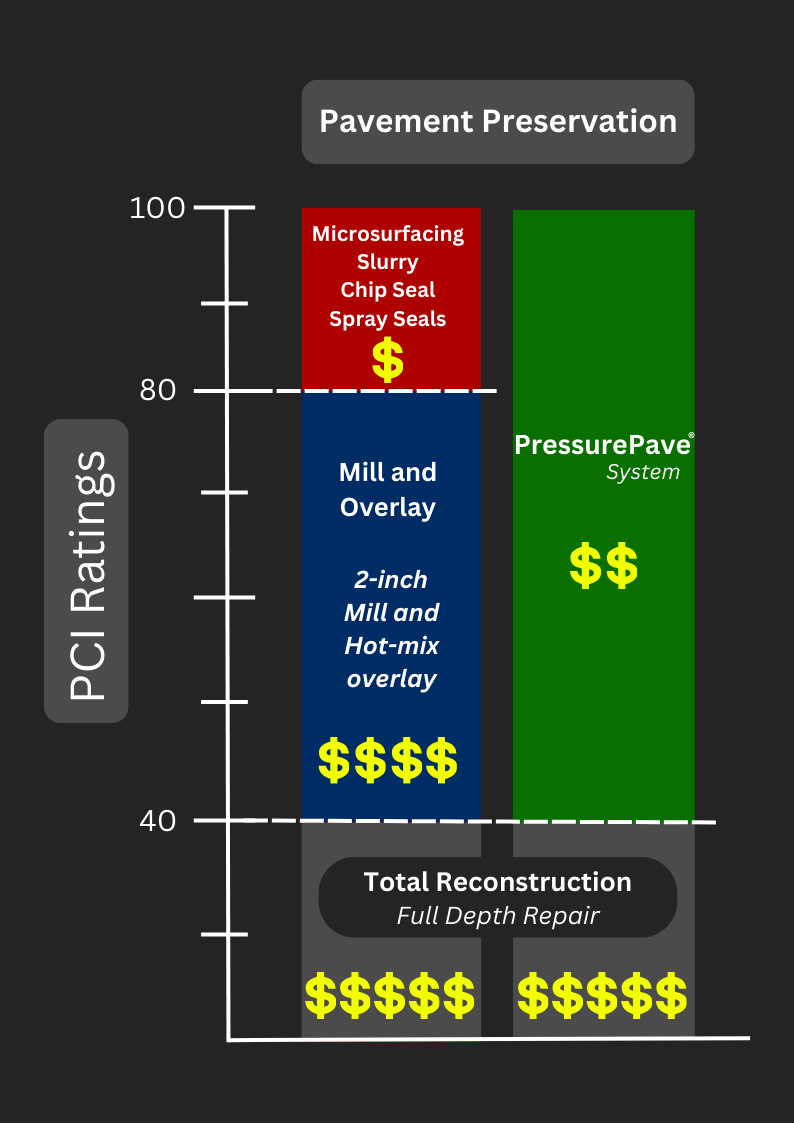
As pavement deteriorates, the treatments available to an agency become more intensive and typically more expensive. The goal is to identify the right treatment while enough of the existing roadway remains worth preserving.
Treatment Comparison
Match the Treatment to the Road.
The Rehabilitation Window
A Road Can Be Too Distressed for Preservation— Without Being Ready for Reconstruction.
PressurePave® is designed primarily for distressed pavement in approximately the 40–70 PCI range.
Roads in this range may have significant cracking, raveling, potholes, surface irregularities, or other visible distress while still retaining enough structural integrity to be rehabilitated.
That gives municipalities another option between lighter preservation treatments and more intensive conventional rehabilitation.
Candidate Selection Matters
PressurePave® Is Not for Every Road.
PCI is an important screening tool, but pavement condition alone does not determine treatment selection. Structural integrity, drainage, base condition, traffic, cracking severity, and project objectives should all be considered.
Roads with significant structural or subgrade failures may require repairs or reconstruction before a surface rehabilitation treatment can provide the desired performance.