Cities face growing demands for road maintenance, stormwater management, sustainability, and responsible infrastructure spending. As new pavement technologies become available, the question is not simply which technology is “better”—it is which technology is designed to solve the problem at hand.
PressurePave® and permeable pavement systems provide a useful example. Both can contribute to municipal infrastructure programs, but they approach pavement from very different directions.
Roadway Rehabilitation
PressurePave®: Rehabilitating the Road Already There
PressurePave® is designed for the rehabilitation of distressed asphalt and concrete pavement that still retains sufficient underlying structural integrity.
Rather than removing substantial portions of the existing pavement, the system works with the roadway already in place.
PressurePave® combines three functions during one continuous paving operation: pressure injection into existing cracks and distressed areas, creation of a stress-absorbing mastic layer, and placement of the finished MAQS® driving surface.
Where PressurePave® Can Provide an Advantage
- Distressed pavement rehabilitation: Designed for roadways where cracking and deterioration have progressed beyond the ideal range for lighter preservation treatments.
- Reduced removal: Preserves more of the existing roadway rather than requiring large quantities of pavement to be milled and replaced.
- Cost efficiency: For appropriate candidate roads, PressurePave® can cost approximately half as much as conventional mill and overlay.
- Rapid return to traffic: Under normal project conditions, treated roadway can typically begin reopening to traffic in approximately 30 minutes.
- Crack treatment: The process fills cracks, voids, and distressed areas while creating a stress-absorbing layer beneath the finished surface.
- Long-term performance: Donelson Construction continues to document PressurePave® driving surfaces after years of service to evaluate pavement performance over time.
Where PressurePave® Is Not the Answer
PressurePave® is not intended to replace every pavement treatment.
Roads suffering from major structural or subgrade failures may require repairs or reconstruction before a surface rehabilitation treatment can provide the desired performance.
PressurePave® is also not a permeable pavement system. Its purpose is to protect the pavement from water infiltration—not allow stormwater to intentionally pass through the finished surface.
Stormwater Management
Permeable Pavement: Letting Water Move Through the Surface
Permeable pavement systems are designed around a very different objective. Instead of preventing water from entering the pavement system, they intentionally allow stormwater to move through the surface into an engineered structure below.
Permeable pavement can include porous asphalt, pervious concrete, and permeable interlocking concrete pavement systems.
These systems can be particularly valuable where stormwater runoff, drainage, water quality, or groundwater recharge are important project objectives.
Where Permeable Pavement Can Provide an Advantage
- Stormwater management: Water can pass through the pavement surface rather than immediately becoming surface runoff.
- Reduced runoff: Properly designed systems can help reduce the volume and rate of stormwater entering conventional drainage infrastructure.
- Water quality: Permeable systems can contribute to stormwater-management strategies intended to reduce pollutants carried by runoff.
- Groundwater recharge: Depending on site design and soil conditions, water can infiltrate into the underlying soil rather than being directed entirely into a storm sewer.
- Site-planning flexibility: Permeable pavement can combine a usable paved surface with a stormwater-management function.
What Must Be Considered With Permeable Pavement?
The benefits of permeable pavement depend heavily on proper system design, construction, site conditions, and long-term maintenance.
- Maintenance: Sediment and debris can reduce surface permeability over time, making routine maintenance an important part of the pavement management plan.
- Underlying system: The pavement is only one component. Base materials, storage capacity, drainage, soils, and site hydrology all influence system performance.
- Traffic and loading: Pavement type and structural design must be selected for the anticipated traffic and loading conditions.
- Climate: Freeze-thaw conditions, winter maintenance practices, and local environmental conditions should be considered during design.
- Project cost: Initial construction requirements can differ substantially from those of a conventional pavement system, particularly when additional subsurface infrastructure is required.
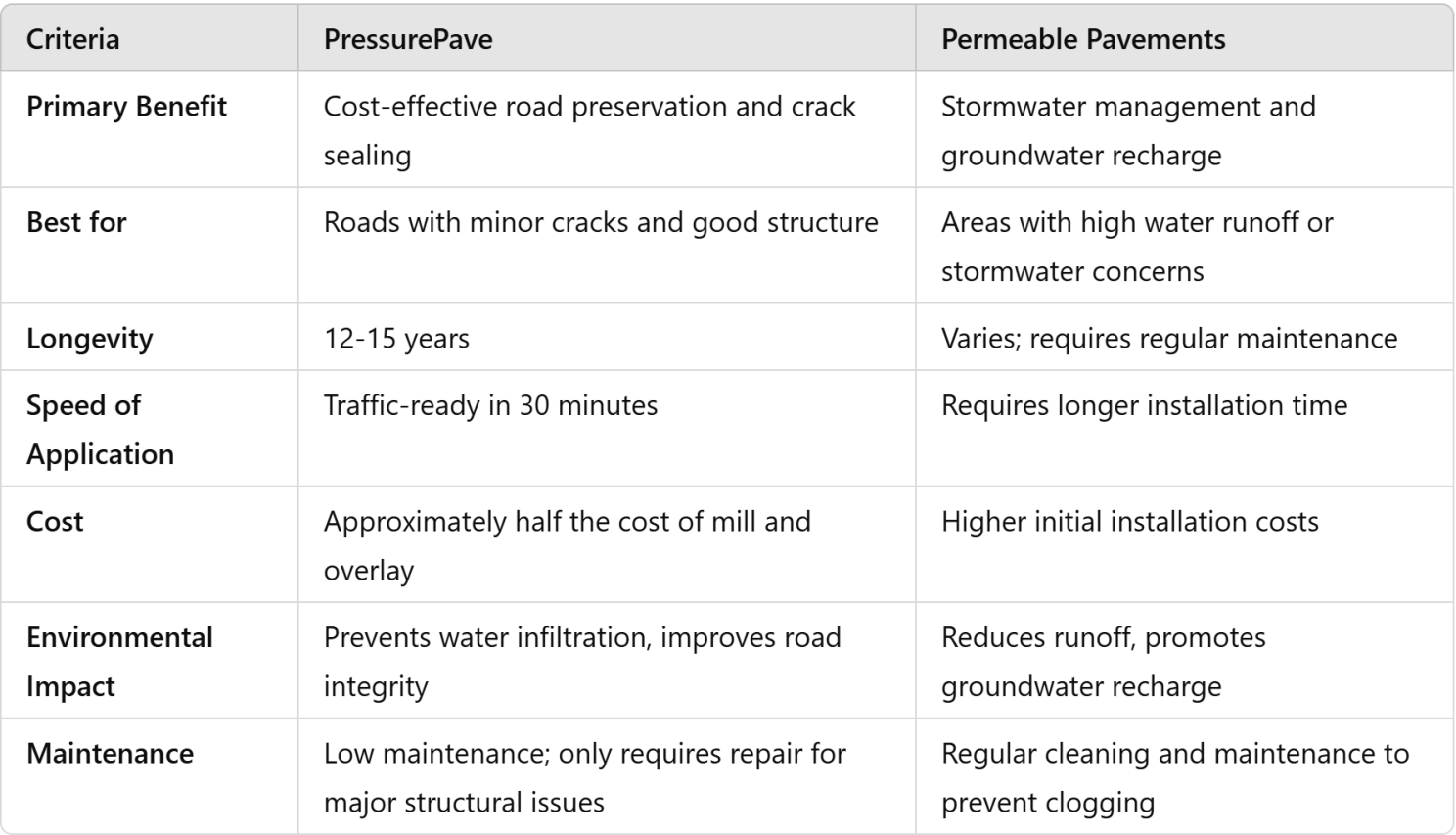
Side-by-Side Comparison
Two Pavement Technologies. Two Different Objectives.
Looking at the systems side by side makes the distinction easier to understand. PressurePave® is focused on rehabilitating an existing distressed roadway, while permeable pavement is primarily designed around managing water within a newly designed pavement system.
Treatment Selection
Which Solution Fits the Project?
The most useful comparison is not simply which pavement technology has the longest list of advantages. The better question is: What is the municipality trying to accomplish?
What About Long-Term Pavement Performance?
Initial construction is only part of the pavement-management decision. Agencies also need to consider how a pavement system performs after years of traffic, environmental exposure, maintenance, and movement beneath the finished surface.
Donelson Construction continues to document older PressurePave® projects, including residential streets, collectors, cul-de-sacs, and higher-traffic roadways.
Following those surfaces over time provides a clearer picture of how the rehabilitation system performs beyond the day it is installed.
Sustainability Is Bigger Than One Metric
Permeable pavement can provide environmental value through stormwater management. PressurePave® approaches sustainability from another direction by preserving more of the existing roadway and reducing the amount of pavement that must be removed and replaced.
These are different environmental objectives, and both can be important depending on the needs of the project.
Evaluating sustainability therefore requires looking beyond a single characteristic. Material consumption, hauling, waste, stormwater, maintenance, pavement life, and future rehabilitation cycles can all influence the overall environmental impact of an infrastructure decision.
Start With the Problem—Then Select the Pavement.
Good infrastructure planning begins with understanding the existing conditions and clearly defining the objective of the project.
If an existing street is deteriorating, pavement condition, structural integrity, cracking, drainage, traffic, and expected service life should help guide the rehabilitation decision.
If stormwater management is driving the project, infiltration requirements, site soils, drainage design, traffic loading, maintenance capability, and local climate become major considerations.
Neither technology should be selected simply because it is innovative. It should be selected because it solves the right problem.
The Bottom Line
The Right Pavement Depends on the Problem You Need to Solve.
PressurePave® and permeable pavements should not be viewed simply as competing versions of the same technology.
PressurePave® is designed to rehabilitate distressed existing pavement while preserving more of the roadway already in place. Permeable pavement is designed to create a paved surface that also participates in stormwater management.
For a municipality trying to rehabilitate a cracked street, PressurePave® may provide a cost-effective alternative to more intensive conventional rehabilitation.
For a project where stormwater infiltration and runoff reduction are central design objectives, permeable pavement may provide capabilities a conventional sealed roadway surface cannot.
The strongest infrastructure programs are not built around one treatment for every situation. They are built around selecting the right technology for the right road, site, and objective.