Municipalities are constantly balancing two competing needs: maintaining more streets while working within a limited roadway budget.
That challenge becomes more difficult because every street is not in the same condition. Some pavements need routine preservation. Others have deteriorated enough that a more substantial rehabilitation treatment is necessary.
PressurePave® was developed to give roadway agencies another tool for that middle portion of the pavement deterioration curve.
The Rehabilitation Window
Designed for Roads That Need More Than Surface Preservation.
PressurePave® is designed primarily for pavement in approximately the 40–70 PCI range.
PCI — or Pavement Condition Index — provides a standardized way to describe pavement condition on a scale from failed pavement to pavement in excellent condition.
Roads in the middle portion of that scale can present an especially difficult decision. The pavement may be too distressed for a light preservation treatment, while still retaining enough structural value that complete reconstruction may not be necessary.
One System. Multiple Problems.
What Makes PressurePave® Versatile?
Traditional pavement preservation treatments are often designed to address a relatively narrow set of pavement conditions. PressurePave® combines several rehabilitation functions into one continuous operation.
- Can be used on both asphalt and concrete pavement.
- Treats existing cracks, voids, and distressed areas before the finished surface is placed.
- Creates a stress-absorbing intermediate layer between the existing pavement and finished driving surface.
- Provides a new MAQS® finished driving surface.
- Allows traffic to return quickly after installation.
Pavement Distress
What Types of Streets Can PressurePave® Handle?
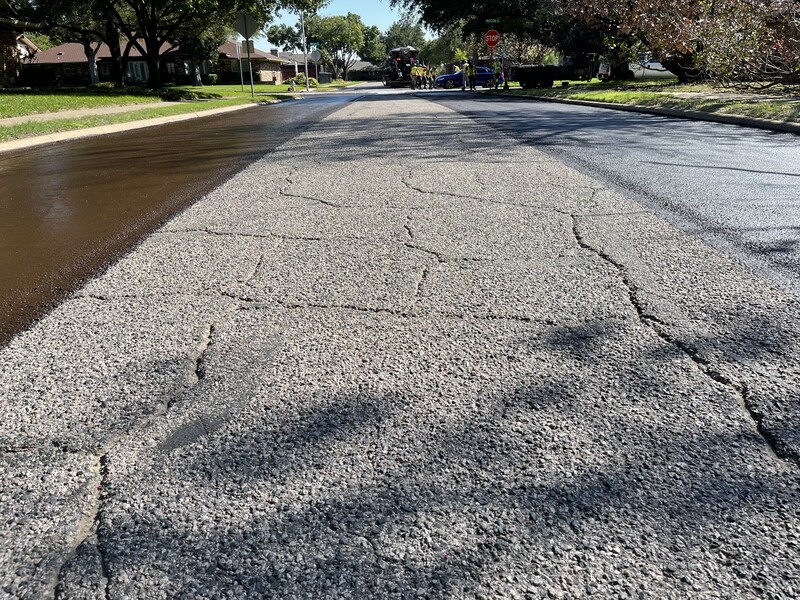
Roads in the rehabilitation range rarely suffer from only one pavement defect. Multiple forms of deterioration often appear together as the pavement ages.
PressurePave® can be considered for candidate roads experiencing conditions such as:
- Alligator cracking
- Block cracking
- Potholes and localized failures
- Raveling
- Surface irregularities
- Reflective cracking
- General surface deterioration
The ability to address several types of distress within the same rehabilitation process can give pavement managers more flexibility when developing a roadway program.
Rehabilitation Is More Than Covering the Existing Surface.
One of the challenges with resurfacing distressed pavement is that movement beneath the new surface can eventually become visible again as reflective cracking.
PressurePave® approaches the problem differently by treating distressed areas and incorporating a stress-absorbing layer beneath the finished MAQS® surface.
The goal is not to suggest that the underlying pavement stops moving. Instead, the system is designed to manage how that movement is transferred through the rehabilitation system.
Pavement Economics
Is PressurePave® Cost Effective?
Treatment cost should not be considered independently from pavement condition and expected service life.
When a roadway has deteriorated beyond the range of lighter preservation treatments, agencies may begin considering more expensive rehabilitation alternatives such as conventional overlays or reconstruction.
For appropriate candidates, PressurePave® can provide another option between light preservation and more intensive removal-and-replacement strategies.
Long-Term Value
Versatility Matters More When the Treatment Performs.
A rehabilitation system is only valuable if the finished pavement continues to perform after installation.
Donelson Construction has continued documenting older PressurePave® projects to observe how the finished driving surfaces respond to years of traffic, weather, and pavement movement.
Those long-term observations provide another important piece of the treatment-selection decision: not simply what the pavement looks like immediately after construction, but how it changes throughout its service life.
Another Tool for the Roads Between Preservation and Reconstruction.
Municipal pavement networks contain everything from newly constructed roads to severely deteriorated streets. No single treatment is appropriate for every condition.
The value of PressurePave® is the rehabilitation window it gives pavement managers between lighter preservation strategies and more intensive conventional rehabilitation.
For roads with the appropriate pavement condition and structural characteristics, that flexibility can help agencies preserve more of their existing infrastructure while addressing cracking, deterioration, ride quality, and the finished driving surface within one rehabilitation system.